
Project 3: The Bog of Eternal Stench? – Evolutionary Responses in Bog Ecosystems under Climate Change
Principal Investigators: Elisa Schaum and Kathrin Otte
PhD student: Melina Sophia Welling
This research project investigates how key algae species in Hamburg’s boglands adapt to warming as an aspect of climate change. The focus is on Zygnematophyceae, a group of plant-like algae crucial for carbon cycling and as indicators of environmental shifts. Using strains from the Hamburg collection along side freshly isolated strains, experiments simulate warming scenarios in controlled conditions using individual species and communities. Some communities are periodically "reset" to original compositions, allowing researchers to conceptually assess the repeatability of evolutionary responses and better understand potential effects of planned restoration efforts. The goal is to understand the speed and nature of phenotypic (e.g. size, carbon dioxide uptake, oxygen production) and genotypic changes. Genetic analyses and advanced AI technologies are employed to monitor development over approximately one year, which amounts to approximately 100 Zygnematophyceae generations. The results will be integrated with long-term data from the citizen science project DesmidHH, linking evolutionary changes to natural environmental variations.
This study aims to clarify how species composition, environmental factors, and evolutionary adaptations are interconnected, especially under global warming. The insights gained will support future conservation and restoration strategies for bog ecosystems, which play an important role in the global carbon cycle.
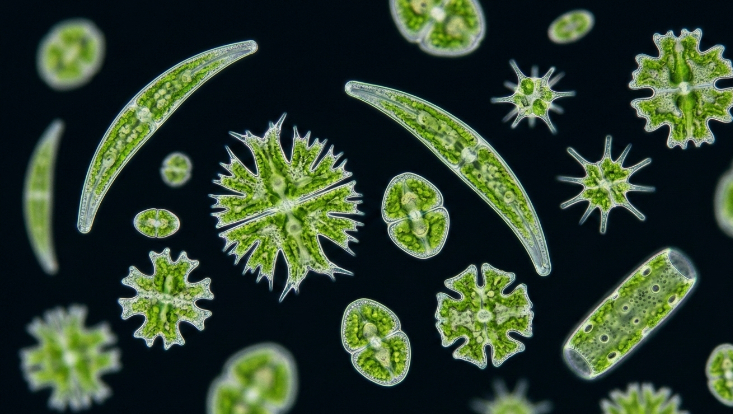
Foto: Melina Sophia Welling (KI (Gemini) generated)