LFF-RAC: Connecting biological collections and data science to understand evolution in a warmer world
Connecting biological collections and data science to understand evolution in a warmer world
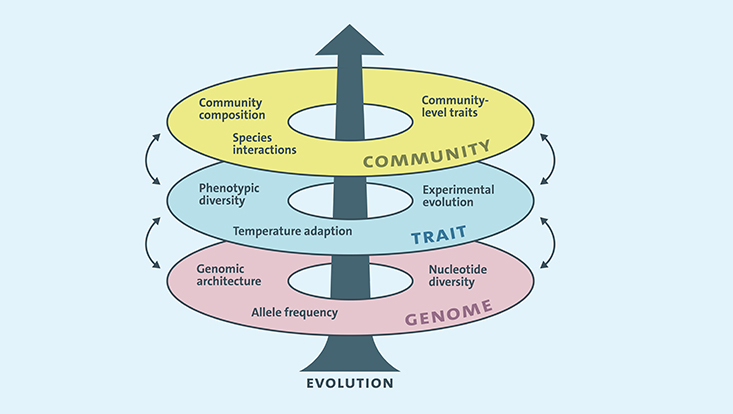
Our research initiative aims to better understand and predict the impacts of global change on biodiversity. The rapid decline in the numbers of many species, caused by habitat loss, climate change and agriculture, threatens not only ecosystems, but also gives rise to global challenges, particularly with regard to food security. Currently, a mechanistic understanding of species' (korrekt: species’) adaptability at genetic, trait-based, and community levels is lacking. Our approach combines historical collections with living populations at the University of Hamburg and the Leibniz Institute for Biodiversity Research (LIB). Together with LIB, the Institute of Plant Sciences and Microbiology (IPM), the Institute of Animal Cell and Systems Biology (IZS), the Institute of Marine Ecosystem and Fishery Research (IMF), and the Hub of Computing and Data Science (HCDS), we develop data-driven forecasts through genomics, museomics, metabarcoding, and AI. The goal is to quantify the adaptability of species, communities, and ecosystems in Northern Germany and derive conservation measures. We analyze all levels of evolution—from genomes to communities—to identify key mechanisms. A central focus is developing innovative data analysis methods, particularly for handling large datasets generated by modern technologies.
Additionally, we support the next generation of scientists through interdisciplinary training, collaborations, and the expansion of digital research infrastructures. In the long term, we aim to establish a digital network of biological collections and foster close collaborations between research, education, and sustainability in order to find solutions to urgent environmental challenges and strengthen biodiversity conservation amid the climate crisis.