
Research
Plant Pathogens
Botrytis cinerea is a necrotroph fungal pathogen infecting a number of plant species including important crops. Besides phytotoxic compounds, B. cinerea produces small RNAs to target plant genes for silencing. This virulence strategy has been termed cross-kingdom RNAi (Weiberg et al. 2013).
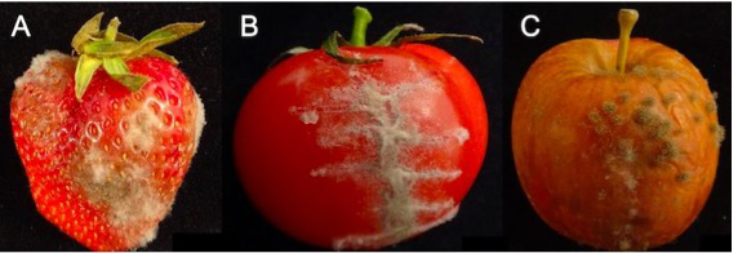
The Botrytis grey mold disease
Hyaloperonospora arabidopsidis is an obligate biotroph parasite belonging to the class of the Peronosporales encompassing many downy mildew pathogens. As an obligate pathogen, H. arabidopsidis is highly adapted to colonize Arabidopsis thaliana plants. For its pathogenesis, Hyaloperonospora forms specialized infection structures, called haustoria forming an intimate contact site to infected host cells. Via these contact sites, the pathogen delivers effector molecules into the plant cells to manipulate host immunity. Hyaloperonospora also transports small RNAs into plant cells for gene silencing that promote infection. (Dunker et al. 2020).
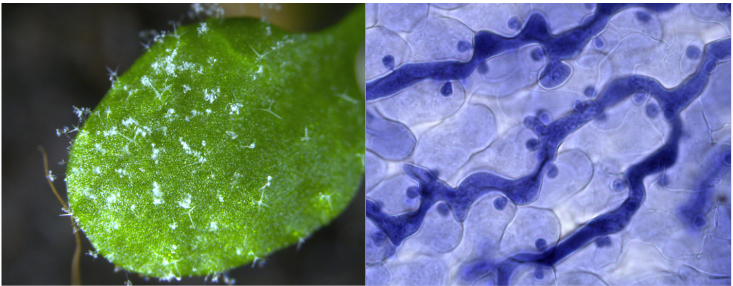
Left: the downy mildew syndrome on Arabidopsis leaves, right: Hyaloperonospora haustoria in a colonized Arabidopsis seedling
Cross-kingdom RNAi
Cross-kingdom RNAi
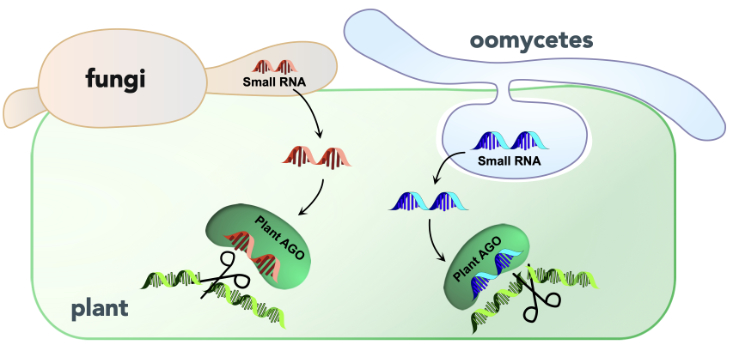
Microbial pathogens deliver small RNAs into host plants to promote infection. These pathogen small RNAs bind to plant Argonaute proteins to form an RNA-induced silencing complex (RISC), which suppresses host gene expression in a sequence-specific fashion. This virulence mechanism has been described as cross-kingdom RNAi (Weiberg et al. 2014, Dunker et al. 2020).
Cross-kingdom RNAi Reporter
We have developed strategies in the lab to detect and track the transfer of RNA molecules between pathogens and host plants. For instance, we implemented a novel type of cross-kingdom RNAi reporter system into plants to follow small RNA delivery during the infection process by life imaging microscopy. This allows us to better understand the spatial-temporal dynamics of RNA delivery and its impact on infection and disease progression (Cheng et al., 2023).
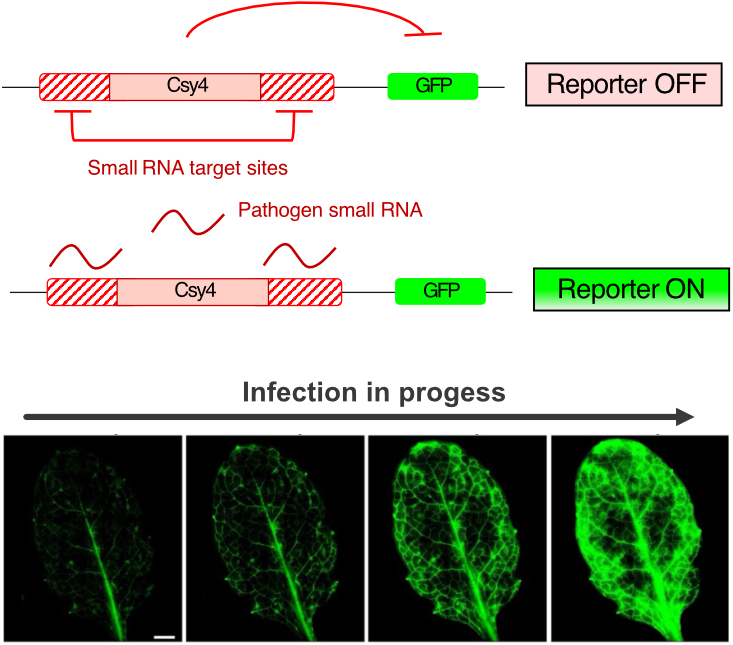
Top: Schematic view of a cross-kingdom RNAi reporter contruct for plant expression. Csy4 encodes an RNA endonuclase that cleaves via a RNA recognition site (Csy4-binding site) fused to an GFP reporter gene. The Csy4 transgene is fused to target sequences of pathogen small RNAs. Sucessful delivery of pathogen small RNAs into reporter plants during infection induces silencing of the Csy4 transgene that leads to GFP activation, as seen in a infection time course (see leaf image series at the bottom).
Extracellular vesicles
How RNAs are transported between pathogens and host cells is currently not well understood. Extracellular vesicles are 50-50 nm sized lipid nanoparticles that have been found in microbes and plants. Recent research has uncovered EVs enclose different types of biomolecules including peptides and RNA (Ruf et al. 2022). Botrytis cinerea releases EVs to translocate small RNAs into plant cells during infection. We are currently investigating the molecular and cellular mechanisms and processes of EV-based RNA delivery. Learning from pathogens how to effectively deliver small RNAs into plants is promising to engineer novel nanoscale tools for delivery of biomolecules into plants to enhance plant health and performance.
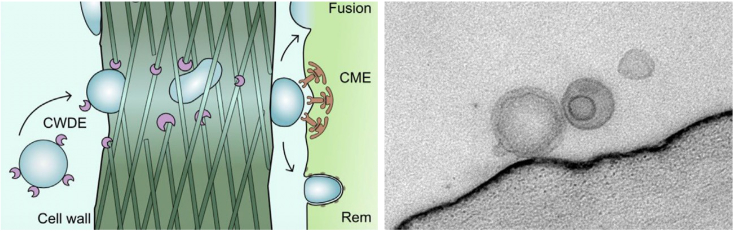
Left: Current model of pathogen EV-interaction with plant cells. Right: Snap shot of Botrytis EVs at the surface of an Arabidopsis leaf cell (electron microscopic image in collaboration with Prof. A. Klingl, LMU München)
Argonautes
Argonautes
Argonautes (AGO) are small RNA-binding proteins that mediate gene silencing of target mRNA by sequence homology. AGOs are structurally and functionally highly conserved in eukaryotic microbes, plants and animals. AGOs are central in the cross-kingdom RNAi mechanism, and microbial pathogens as well as plants send small RNAs into its interacting partner to bind the host AGO for targeted gene silencing (Cheng et al. 2025). We are currently investigating how external small RNAs get access to host AGOs to induce cross-kingdom RNAi.
AGO immunocapture and small RNA sequencing analysis
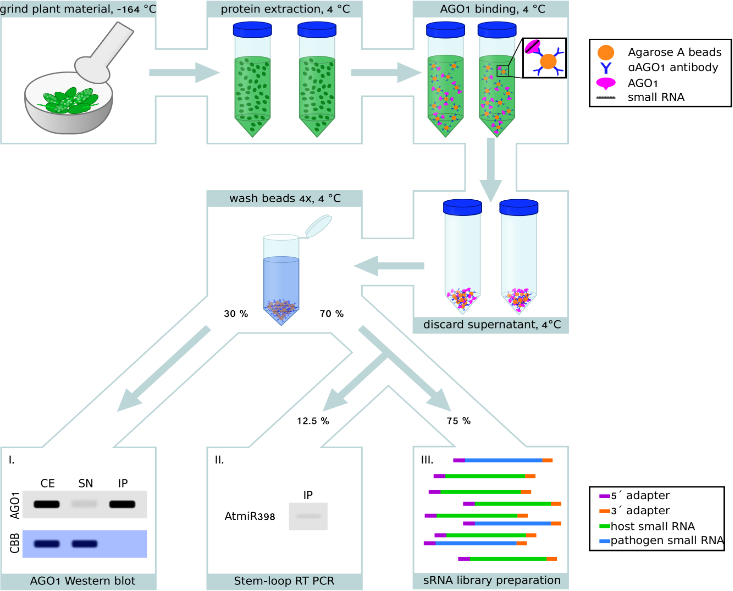
To study cross-kingdom small RNAs, we have developed biochemical methods to isolate AGOs from infection sites to analyse AGO-bound RNAs. For instance via immuno-capturing coupled to high throughput sequencing, we are characterizing pathogen small RNA that have been delivered into plant AGOs during infection (Dunker et al. 2021).
Retrotransposons und small RNA diversity
During infection, Botrytis cinerea produces large amounts of retrotransposon-derived small RNAs. Some of these retrotransposon small RNAs have been proven to induce cross-kingdom RNAi in different plant species. We found that natural isolates of B. cinerea are very diverse in retrotransposon small RNA production (Porquier et al. 2021) that correlates with the level of infectivity. We are interested to understand the relationship between retrotransposon diversity, small RNA production, infectivity and host preference.
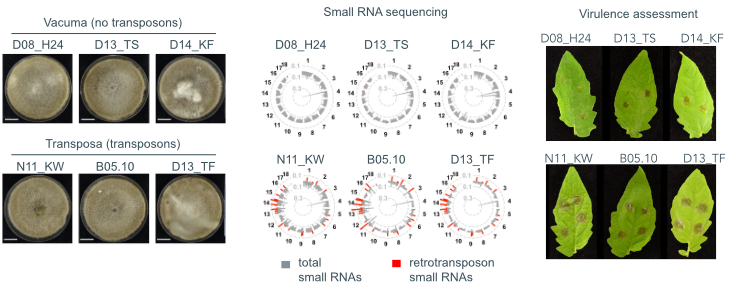
Left: Botrytis wild isolates, middle: small RNA sequencing profiles, right: Botrytis infection assay on tomato leaves