Fachbereich Biologie
FachbereichBiologie
Foto: UHH/Denstorf
1. Juli 2026, von Dr. Ifey Alio
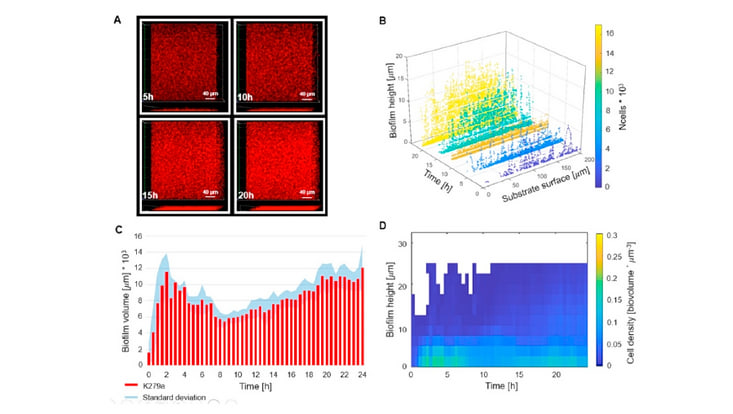
Foto: UHH/Mikrobiologie
Pathogenic multispecies biofilms are major drivers in the persistence and virulence of bacterial infections, complicating treatment due to their pronounced antibiotic resistance. To better understand the temporal and spatial dynamics within these complex communities, we established dual-species biofilm models focusing on the pathogen Stenotrophomonas maltophilia in combination with Pseudomonas aeruginosa and Staphylococcus aureus. Using Lattice Light Sheet Microscopy (LLSM) and automated cell quantification, we demonstrated the dynamic growth and complex spatial organization of these dual-species biofilms. The study identified both shared and species-specific strategies of biofilm formation, ultimately underscoring the dynamic and adaptive nature of the S. maltophilia K279a biofilm architecture. A vertical zonation was a general and pronounced trait of S. maltophilia biofilms. Marker gene expression in S. maltophilia was generally heterogeneous across the biofilm layers but followed a clear time-dependent on/off pattern. Iron transport and cytochrome biosynthesis appear to be key traits involved in niche competition. Furthermore, S. maltophilia attenuated P. aeruginosa N-acyl-homoserine lactone (AHL) quorum sensing (QS)-regulated gene expression involved in surface colonization, outer membrane biogenesis, and cyclic di-GMP signaling. Thereby we identified key drivers involved in the S. maltophilia dualspecies biofilm lifestyle, representing potential drug targets to combat multi-species and heterogeneous biofilm infections.
Published in December 2026 in Biofilm Volume 12 (Elsevier)