
PhD projects
The 11 nEXt-RNA doctoral candidates (DCs) will work on collaborative research projects led by exRNA experts working on different host-pathogen systems and species; spanning virology, microbiology, nematology, plant and mammalian biology and covering various life science disciplines of molecular biology, cell biology, pathology, immunology, bioinformatics.
The DC projects are further connected within topic-related work packages (WPs) and through collaborations with associated partners both from academic and non-academic, business-related sectors forming a unique and highly synergistic interdisciplinary and intersectoral research network to educate DCs through secondments, network-wide training activities and mentorship programmes.
The individual DC project description below provide further information on specific research objectives, expected outcome, share methods and planned secondments.
- -> Project DC1
Tracking ex-mRNAs from the fungal pathogen Ustilago maydis to its crop plant maize - -> Project DC2
Exploring the role of extracellular RNA in plant viral and viroid infections - -> Project DC3
Mechanisms of cross-species RNAi in host-bacteria interactions - -> Project DC4
Quantitative biochemical model for cross-species RNAi in intestinal infection - -> Project DC5
Exploring fungal EV attachment and uptake into plant cells - -> Project DC6
Comparing exRNA uptake, specificity, and localization when transported by different carriers - -> Project DC7
Extracellular vesicle characteristics and molecular mechanisms that drive RNA cargo delivery into human cells - -> Project DC8
Engineering Citrus-Derived Nanovesicles for RNA Delivery in human cell models - -> Project DC9
Develop microalgae EV (M-EV)-based therapeutics against the fungal pathogen Botrytis cinerea - -> Project DC10
Learning from nature: exploring and applying delivery of ex-mRNA into plant and mammalian hosts - -> Project DC11
Engineer RBPs for improved small RNA delivery and action in target cells
Work packages
WP1: Mechanisms of cross-kingdom exRNA transmission
WP2: Mechanisms of exRNA uptake and delivery
WP3: Next exRNA application and innovations
Project DC1
|
WP1 |
Supervisor:
Prof. Dr. Michael Feldbrügge, University of Düsseldorf (UDUS)
Email: feldbrue@hhu.de
Title:
Tracking ex-mRNAs from the fungal pathogen Ustilago maydis to its crop plant maize
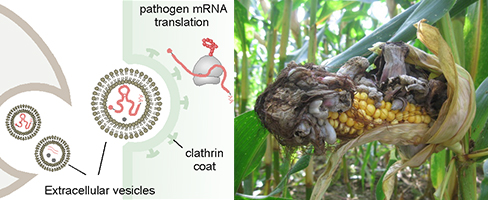
Photo: M. Feldbrügge
Co-supervisor:
Prof. Dr. Eva Tutucci, University of Amsterdam
Project objectives:
-
Develop novel tools to track and visualize RNA transmission
-
Identify ex-mRNA functional interaction partners relevant for the transmission
-
Explore functional roles and modes-of action of exRNAs in target cells
Expected outcome:
- Understand the biological function and the underlying mechanisms of extracellular mRNA delivery during host-microbe interaction
Methods:
- RNA live imaging
- Fluorescence in situ hybridisation (FISH)
Secondments:
- Research stay at the University of Amsterdam to conduct FISH experiments
Project DC2
|
WP1 |
Supervisor
Prof. Dr. Kriton Kalantidis, University of Crete (UoC)
Email: kriton"AT"imbb.forth.gr
Title:
Exploring the role of extracellular RNA in plant viral and viroid infections
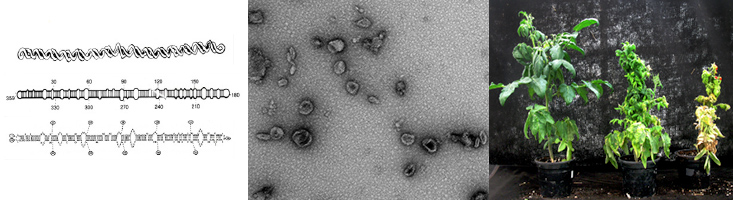
Photo: K. Kalantidis
Co-supervisor:
Prof. Dr. Esther Nolte t´Hoen (University of Utrecht)
Project objectives:
-
Identify the content of extracellular space of virus- and viroid-infected plants, both inside and outside of EVs
-
Investigate the fate of exRNAs, including their cellular fate
-
Investigate the function of exRNAs in virus- and viroid-infected plants
Expected outcome:
- Discover exRNAs of the apoplastic space with importance for viroid biology
- Discover cellular and apoplastic proteins important for viroid infections or in the defence against viroids
Methods:
-
Advanced RNAi reporters
-
Tissue culture
-
Confocal and electron microscopy
Secondments:
- Research stay at University of Hamburg to develop RNAi reporters
Project DC3
|
WP1 |
Supervisor:
Prof. Dr. Lionel Navarro, University of Paris (ENS)
Email: lionel.navarro@bio.ens.psl.eu
Title:
Mechanisms of cross-species RNAi in host-bacteria interactions
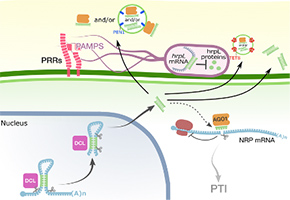
Photo: L. Navarro
Co-supervisor:
Dr. Stefania Raimondo (University of Palermo)
Project objectives:
- Determine plant and human AGOs for internalization into pathogenic bacteria and their contribution to AGS
- Establish reporter assays to monitor ex-sRNA activity in bacterial cells
Expected outcome:
- Define factors required for uptake and function of AGOs in recipient bacterial cells
- Build resources to monitor spatio-temporal dynamics of exRNAs
Methods:
- Molecular Biology
- CRISPR-endonuclease-based switch-on siRNA reporter system
- Quantitative LC MS/MS, Turbo-LOV proximity labelling
Planned secondments:
- Research stay at University of Hamburg to develop RNAi reporter systems in bacteria
- Research stay at University of Düsseldorf to optimize Turbo-LOV proximity labelling in bacteria
Project DC4
|
WP1 |
Supervisor:
Prof. Dr. Amy Buck, University of Edinburgh (UEDIN)
Email: a.buck"AT"ed.ac.uk
Title:
Quantitative biochemical model for cross-species RNAi in intestinal infection
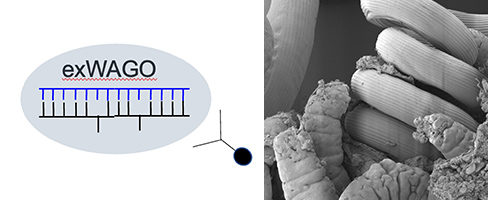
Photo: A. Buck
Co-supervisor:
Dr. Cei Abreu-Goodger (University of Edinburgh)
Dr. Matthias Hackl (TAMIRNA)
Project objectives:
- Determine absolute copy numbers and target recognition rules of parasite RNAs inside murine intestinal cell populations
- Identify host proteins associated with parasite RNA-induced silencing complexes
- Build reporter assays for cross-species RNAi via exWAGO to compare specificity and efficacy in different species
Expected outcome:
- Quantitative data on exRNAs delivered naturally by exWAGO to mammalian cells
- New host targets associated with gastrointestinal nematode infection and strategies to block their de-regulation during infection.
- New tools to examine and compare cross-species RNAi via exWAGO in mammals, plants and bacteria
Methods
- Cell and intestinal organoid culture
- FACS
- Bind-n-seq, immunoprecipitation, computational analyses of small RNA/targets
- Reporter design and gastrointestinal nematode infection model
Planned secondments
-
Research stay with TamiRNA for parasite exRNA quantification
-
Research stay at University of Hamburg to design cross-species RNAi reporters
-
Research stay at University of Paris to test exWAGO and human exAGO in bacteria
Project DC5
| WP2 |
Supervisor:
Prof. Dr. Arne Weiberg, University of Hamburg (UHAM)
arne.weiberg@uni-hamburg.de
Title:
Exploring fungal EV attachment and uptake into plant cells
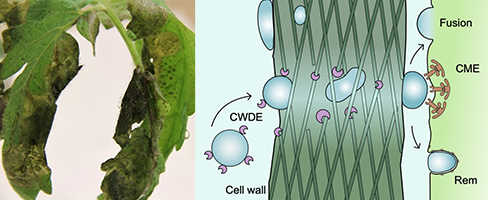
Photo: A. Weiberg, Ruf et al. 2022 (CC BY 4.0)
Co-supervisor:
Prof. Dr. Kriton Kalantidis (University of Crete)
Project objectives:
- Use proximity labelling to characterize fungal EV surface proteins and plant cell surface factors interacting with fungal EVs
- Characterize EV surface proteins for their role in EV attachment and uptake into plant cells
Expected outcome:
- Identify fungal and plant proteins involved in EV uptake
- Gain knowledge on fungal EVs to deliver exRNA to various cell types
- Correlate EV uptake and fusion for RNA delivery in plants
Methods:
- EV proximity labelling
- EV-FUSIM technologies
Secondments:
- Research stay at University Düsseldorf to establish TURBO-LOV proximity labellin
- Research stay at Utrecht University to establish EV-FUSIM in plants
Project DC6
| WP2 |
Supervisor:
Prof. Dr. Amy Buck, University of Edinburgh (UEDIN)
Email: a.buck@ed.ac.uk
Title:
Comparing exRNA uptake, specificity, and localization when transported by different carriers
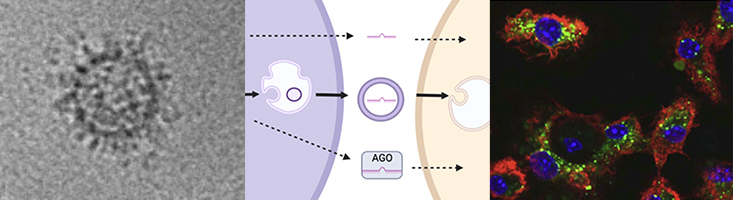
Photo: A. Buck, White et al. 2023 (CC-BY)
Co-supervisor:
Prof. Dr. Esther Nolte-t’Hoen (University of Utrecht)
Project objectives:
- Compare cellular specificity of exRNA uptake by mammalian cells and organoids when delivered via EVs, RNA-binding proteins or naked (non-complexed).
- Determine differences in sub-cellular localization of imported exRNAs and their associated protein co-factors based on parasite carrier
- Compare functional differences of exRNA imported by different carriers using reporter assays
Expected outcome:
- Cross-system comparison on natural exRNA uptake mechanisms and new or refined strategies for therapeutic exRNA delivery
- New knowledge on sub-cellular localization and protein co-factors of exRNAs inside cells and correlation with functional activity
Methods:
- ExRNA/EV purification (Ultracentrifugation and Size exclusion chromatography)
- Fluorescent labelling of exRNAs/carriers, Spectral and Imaging Flow, confocal microscopy
- Cell and intestinal organoid culture and gastrointestinal nematode infection model.
Secondments:
- Research stay at Utrecht University to track exRNA import with reporter / fusion assays and compare subcellular localization to other EV forms.
Project DC7
| WP2 |
Supervisor:
Prof. Dr. Esther Nolte t´Hoen, Utrecht University (UU)
Email: E.N.M.Nolte@uu.nl
Title:
Extracellular vesicle characteristics and molecular mechanisms that drive RNA cargo delivery into human cells
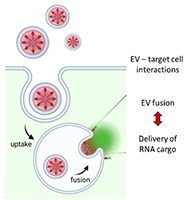
Photo: E. Nolte van´t Hoen
Co-supervisor:
Prof. Dr. Amy Buck (University of Edinburgh)
Project objectives:
- Compare EVs from various species/pathogens for their capacity to interact and/or fuse with human cells to deliver RNA cargo
- Identify cell binding/internalization routes that support EV binding/fusion and RNA cargo delivery
- Assess the relationship between EV-fusion and subcellular exRNA delivery site and exRNA function
Expected outcome:
- Cross-species discovery of EV types that promote endosomal escape in mammalian target cells (and therefore promising candidates for EV therapeutics)
- Understanding of (common) molecular features of EVs that promote EV fusion and cargo delivery
- c) Understanding if and how subcellular compartments support EV fusion and functional exRNA delivery
Methods:
- EV isolation methods
- Diverse techniques to fluorescently label EVs
- EV characterization methods
- Genetic engineering of cells to produce EVs with molecular tags or reporter constructs
- EV-FUSIM technology for live cell microscopic imaging of EV binding, uptake and fusion in time and space
- Flow cytometry to quantify binding/uptake of EVs to diverse cell types
- Setting up novel technology for parallel live cell imaging of ExRNA and EV fusion
Secondments:
- Research stay at Aarhus University to learn (live) tracing of (EV-associated) exRNAs
Project DC8
| WP3 |
Supervisor:
Dr. Stefania Raimondo, University of Palermo (UNIPA)
Email: stefania.raimondo@unipa.it
Title:
Engineering Citrus-Derived Nanovesicles for RNA Delivery in human cell models
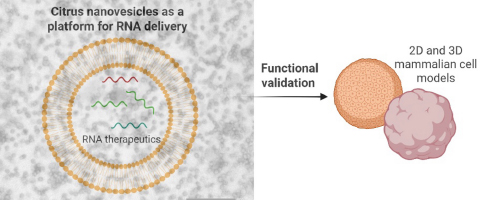
Photo: BioRender, Tinnirello et al. (CC BY)
Co-supervisor:
Alice Conigliaro (NAVHETEC)
Project objectives:
- develop citrus-derived nanovesicles (CDNVs) as a novel and sustainable platform for RNA delivery
- investigate both the endogenous RNA cargo of CDNVs and strategies for efficient exogenous RNA loading
Expected outcome:
- identification of optimal methods for RNA encapsulation, the evaluation of CDNV biodistribution, stability, and targeting in advanced human models
- demonstration of functional RNA delivery in vitro
Methods:
- 2D and 3D human cell models
- Molecular biology
- RNA sequencing
- Imaging approaches
Secondments:
- Research stay at Engreen Technologies to use microalgae and vesicle-based RNA delivery technologies with
- Research stay at Microsynth to advance RNA synthesis and sequencing platform
Project DC9
| WP3 |
Supervisor:
Prof. Dr. Arne Weiberg, University of Hamburg (UHAM)
Email: arne.weiberg@uni-hamburg.de
Title:
Develop microalgae EV (M-EV)-based therapeutics against the fungal pathogen Botrytis cinerea
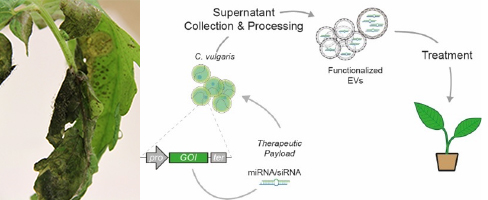
Photo: EnGreen Technol
Co-supervisor:
Dr. Antonio Emidio Fortunato (ENGREEN)
Project objectives:
- Establish RNAi and M-EV fusion reporters in Botrytis
- Design siRNA probes to control Botrytis via M-EV approaches
- Run greenhouse trail to assess efficacies of M-EV approaches
Expected outcome:
- Develop novel M-EV-based applications to control Botrytis in different crops
Methods:
- RNAi reporter systems in pathogens
- M-EV production and plant applications
Secondments:
- Research stay at Engreen Technologies to engineer M-EVs for Botrytis control in crops
Project DC10
| WP3 |
Supervisor:
Prof. Dr. Michael Feldbrügge, University of Düsseldorf (UDUS)
Email: feldbrue@hhu.de
Title:
Learning from nature: exploring and applying delivery of ex-mRNA into plant and mammalian hosts
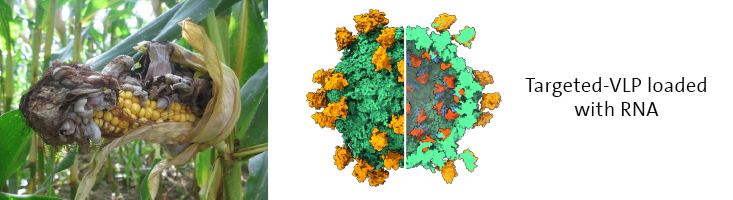
Photo: M. Feldbrügge, Serendip Innovations
https://serendipinnovations.com/
https://www.mikrobiologie.hhu.de/en
Co-supervisor:
Dr. Vianney Poignavent (SERENDIP)
Project objectives:
- Identify new components of EVs involved in loading and delivery of mRNAs
- Study the function of most interesting candidates in detail
- Delivery of mRNAs using orthogonal systems such as virus-like particles for plants or tailor-made EVs for mammalian cells
Expected outcome:
- Apply novel components for tailor-made delivery of mRNAs to target cells
Methods:
- Proximity labelling techniques
- Optogenetics
- Generation and application of Virus-like particles
- EV-FUSIM technology
Secondments:
- Research stay at Serendip Innovations to develop virus-like particle technology
- Research stay at Utrecht University to apply EV-FUSIM technology
Project DC11
| WP3 |
Supervisor:
Prof. Dr. Lionel Navarro, University of Paris (ENS)
Email: lionel.navarro@bio.ens.psl.eu
Title:
Engineer RBPs for improved small RNA delivery and action in target cells
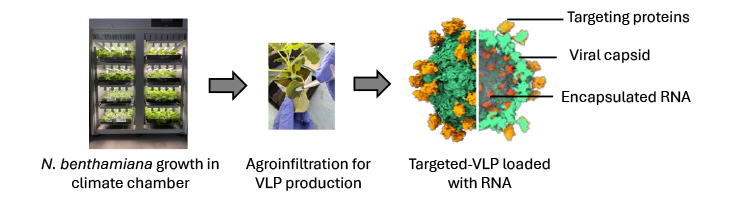
Photo: L. Navarro, Serendip Innovations
Co-supervisor:
Dr. Vianney Poignavent (SERENDIP)
Project objectives:
- Optimize exogenous loading of exAGO/RBP-sRNA into EVs
- Establish VLPs containing exAGO/RBP-sRNA and coated with antibody fragment recognizing proteins at the surface of bacteria or human cells
- Assess the silencing efficacy and antibacterial activity of EV/VLP-based delivery of exAGO/RBP-sRNAs
Expected outcome:
-
Unveiling the best EV-RBP-sRNA composition(s) to trigger gene silencing in bacterial and mammalian cells.
-
Unveiling the best molecular biology approach to load RBP-sRNA in VLPs
-
Strategy to enhance the affinity of VLPs for bacterial and human cells
Methods:
- RT-qPCR, Golden Gate cloning, Low molecular weight Northern analyses, sRNA-seq
- Plant manipulation (Agrobacterium-transient assay in N. benthamiana)
- Protein expression and purification from bacteria, western blot analyses
Secondments:
- Research stay at Serendip Innovations to engineer exAGO/exWAGO/RBPs-sRNA complex into VLPs and enhance their cell targeting capacity